Melbourne International Film Festival: Kim Novak's Vertigo (dir. Alexandre O. Philippe)

Back in 2013, merely weeks into having moved from Melbourne to the United States, I was accepted onto the FIPRESCI jury for the San Francisco International Film Festival. I had briefly spent some time there with an old friend while on a week-long stopover from Australia to my final destination of New York City, only to return shortly after for what turned out to be a fun and enlightening experience—my first such film festival jury. The jury gave our prize to Nights with Théodore. Although I have not seen any of director Sébastien Betbeder’s other work, I remember being transfixed by that Parisian-set nighttime romantic adventure.
But I digress.
While I was there for the festival, the guest team (bless the guest teams!) offered various jurors and VIPs an opportunity to go on a “Vertigo Tour”. A location-by-location van ride around the city to the filming spots of Alfred Hitchcock’s famed Vertigo. The place I had been put up for my stay was already literally just across the street from the Empire Hotel so I was already part of the way there. From the festival hub we visited the Brocklebank Apartments, the Mission Delores, Fort Point beneath the Golden Gate Bridge (shoutout to James Benning’s Eight Bridges!) and various other spots. It was a great way to see the city, even though at the time I likely would not have considered Vertigo among my tip-top Hitchcock films with the likes of Psycho, Rear Window, The 39 Steps, The Birds or Rope. Getting the chance to see Vertigo at this year’s Melbourne International Film Festival, however, and in 70mm no less, has bumped it right up, up, up. What a movie!
Oh, and did I mention who was on the tour with me to all of these Vertigo locations?
Scott Rudin!
And one of his assistants. Ahem.
If you know you know, although I can't say I saw him do anything untoward. Still, what an odd anecdote to have in my history. On another solo walking excursion in San Francisco I even visited the ‘home’ of Tommy Wiseau’s The Room, which was purely by accident.
Anyway, that is all a long way of getting to Kim Novak’s Vertigo, a documentary by cinematic documentarian Alexandre O. Philippe that sadly is not very good and is very easy to get distracted from with other things. It's also impossible to recommend in preference to merely rewatching the grandness of Hitchcock’s film. It’s a movie that doesn’t get much better than its opening shot, a simple black and white film stock image of subject and Hitchcock leading lady Kim Novak, light hitting her face across the eyes ever so, that fades into an arresting image of a setting sun over a moody piece of stringed score by Jon Hegel. I don’t know if this opening necessarily promises a movie that Philippe ultimately can’t deliver on, but it did perhaps prime me for something with a bit more of an atmospheric tone. Something closer to, well, Vertigo than what we actually get.
The film makes maximum use of its access to Novak, both through on-screen interviews with Philippe, audio recordings made by Novak, and memorabilia through her home including quite notably the grey suit and a Vertigo shooting script, partially charred by fires that we learn have engulfed Novak’s home on multiple(!) occasions. Unfortunately, many of the sequences with Novak are shot with a peculiar hazy aesthetic that distracts more so than it suggests any particular idea from Philippe and cinematographer Robert Muratore.
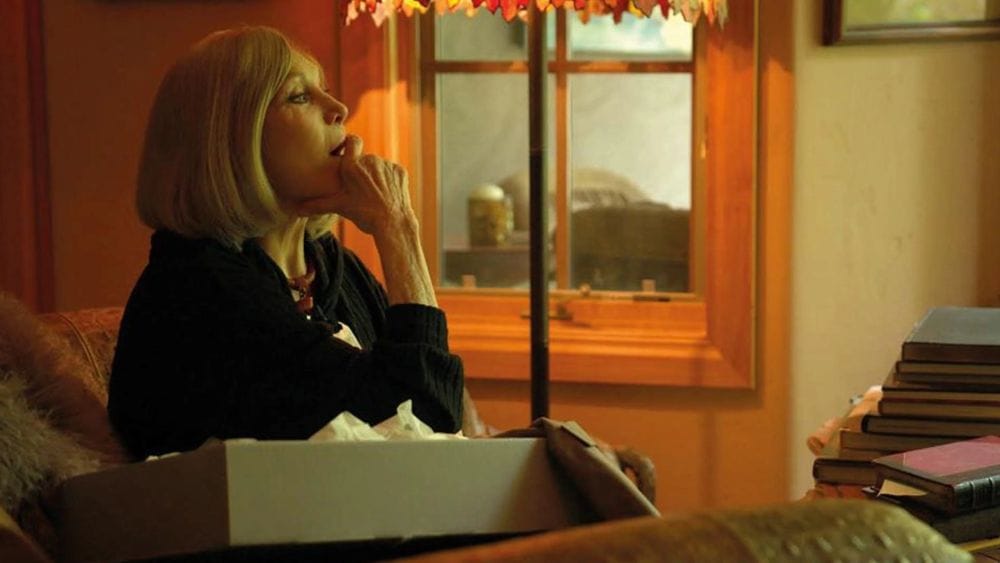
Maybe all the good stuff is being held for a later documentary that is more precisely about Vertigo like Philippe’s earlier films 78/52 (about Psycho) or Memory: The Origins of Alien. Hopefully that film is more in line with my favourites of Philippe’s work, Chain Reactions (review here) about The Texas Chain Saw Massacre, and The Taking about Monument Valley. As it is, Kim Novak’s Vertigo lingers on the Hitchcock film just enough to justify the title. But this documentary is more a general piece about its subject and her life than it is specifically about her experiences with making the ‘50s classic, so widely hailed as the greatest film ever made. We learn of her upbringing, her breakthrough, her success and eventual withdrawal from Hollywood. Novak’s penchant for paining with works that appear to mirror or pull inspiration from Vertigo seems particularly ripe for deeper examination, but it doesn’t quite know how—maybe Novak was reluctant given she is in her 90s. We do hear a lot about her process though, including how unfitting she felt the word “act” really was, especially when working opposite Jimmy Stewart (which she did multiple times). We also learn about her toes.
Kim Novak’s Vertigo is perfectly watchable, and particularly for those with an interest in classic Hollywood and Vertigo in particular. There are nuggets in here worth discovering. The similarities between the creation of “Kim Novak” as a performer and a star being so closely linked to that of Novak's Judy in Vertigo feels like it ought to have been the storytelling hinge with which this documentary swung. Alas, David Lawrence’s editing, so pitch perfect in last year’s Chain Reactions, is unfocused, giving the finished film something of an uncertain quality. What was Philippe attempting to do here? One suspects this is more a film for himself and for Novak than wider audiences who may not quite grasp just how important and incredible Vertigo is if stumbled upon on a streaming service (it’s on SBS On Demand here in Australia following its festival run last month). I watched it after rather than before Vertigo because I wanted the latter to be experienced fresh, having not seen it in at least ten probably more years. It probably wouldn’t have mattered.
If you would like to support documentary and non-fiction film criticism, please consider donating by clicking the above link. Any help allows me to continue to do this, supports independent writing that is free of Artificial Intelligence, and is done purely for the love of it.