Melbourne International Film Festival: Eight Bridges (dir. James Benning)
Sometimes the conversations at film festivals are awfully highfalutin. Lots of discussion that runs into the academic or the high brow. Which, don’t get me wrong, is often part of the fun about film festivals; being able to navigate a story or a character or an image with others in ways that allow for deeper probing than one may otherwise entertain. And then there are time where you get to walk out of a movie called Eight Bridges and ask your fellow filmgoers, “so, what was your favourite bridge?” And maybe you’ll chuckle, but you’re also entirely serious. Because it’s not only the most obvious question to ask, it’s also the most enlightening. Maybe it says a lot about a viewer, or maybe it doesn’t, but you will have an answer and a reasoning and that is where the fun and fascination lies—particularly for a film that, to most viewers, is boring, slow and confounding.
A film like Eight Bridges, directed by festival faithful James Benning, isn’t just eight static shots of eight different bridges in America. To suggest that would be to deny the artistic intent of when and where he cuts. And why. Because there’s nothing random about the choices that Benning makes in any of his films, even if it may appear (either in practice or while explaining it to bemused co-workers) to be the result of a dire lack of imagination. I have not seen all that many considering his vast career, but I’ve seen enough to know I’m generally going to have a good time deciphering his choices and admiring his images in between the sort of brain-diversions that his brand of slow experimental cinema often facilitates. “Who came up with the word ‘bridge’”? “Remember that episode of The Simpsons where Bart joins the scouts?” “Oh, I have to confirm that meeting tomorrow.” You know, that sort of stuff. Throwing the Golden Gate Bridge in right there at the start made me think of Drew Barrymore in Scream, putting the biggest star (such as it is for a manmade structure) up top. “Do you like movies about bridges?” I, quite naturally, wondered if anybody driving across it might be listening to Madonna’s Confessions II.
Traditionally reviewing a Benning film is… well, it’s not exactly foolhardy, it can feel like a bit of a hard task to do in so few words. For that reason I really enjoyed, and therefore recommend, reading Erika Balsom’s Ten Skies, which was a longform monograph that was able to really did into each of its titular tableaus in a way that brought clarity, context and a real targeted eye to the way Benning crafts a frame and builds a visual narrative. My personal favourite Benning films, such as Sogobi, Los, El Valley Centro, and Ruhr generally render me rather speechless. The most illuminating thing I could probably say about Two Cabins is that I watched it and drifted off to sleep only to awaken to darkness outside my window and on the screen, an accidental peak liminal experience where film became life (not a pejorative).
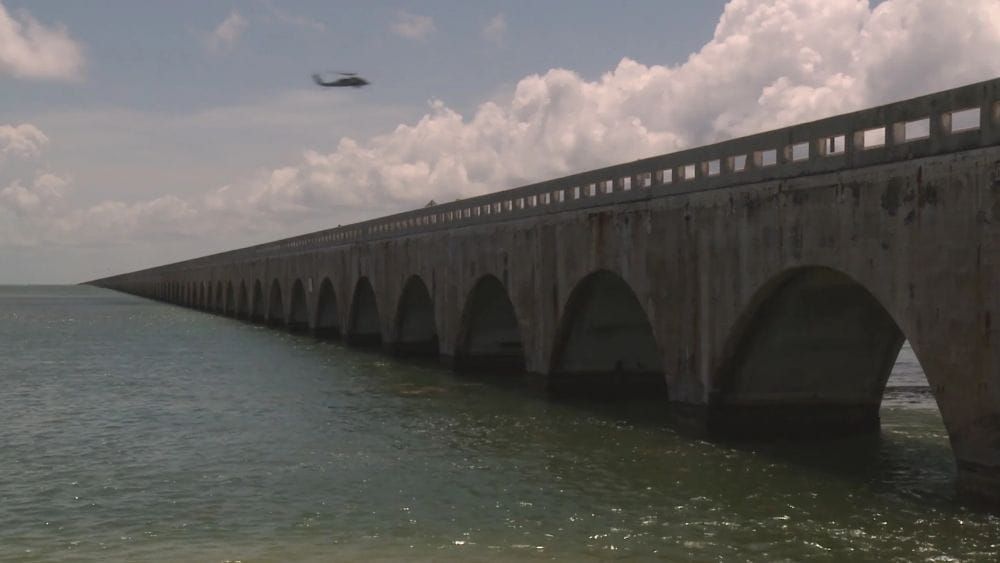
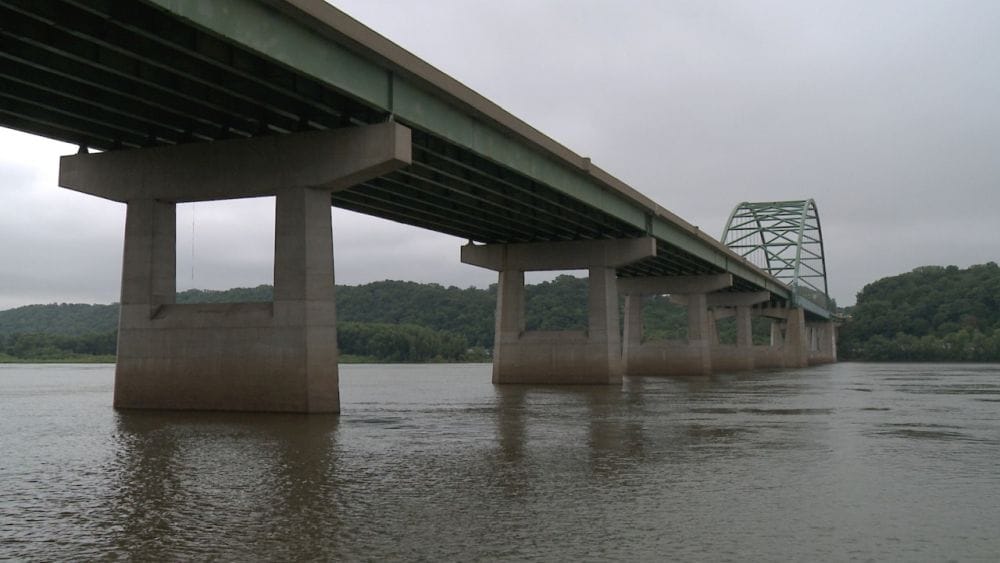
I made notes throughout the film in my little notebook. Some of the legible: “is that more of a viaduct than a bridge?” about the Hi-Line Railroad Bridge in North Dakota (it’s both!). Some of them very much not. No doubt too entranced to really focus all that much on the scribbling I was doing. But I remember the images. I remember the patterns that formed, almost hypnotically so, in the Seven Mile Bridge sequence. How its recurring arches extend far out into the Florida water and how it appears to curve once it meets the horizon where it hugs the water. I remember a shipping container emerging from the right-hand side of the screen in the final sequence, travelling underneath Oregon’s Astoria-Megler Bridge followed by a raft of ducks in the foreground paddling from left to right, as if Benning is giving the audiences who stuck with Eight Bridges’ runtime a last minute nod and a wink with a unexpected sight gag. ‘Thanks for sticking with me!’
This is a rewarding film for those who enjoy Benning’s particular style of filmmaking. I know many do not—several of whom left during the MIFF screening I was at, admittedly a late-afternoon 4pm screening that I expect was a little bit too lethargic for an after-work session. I, a noted falls-asleep-during-anything festivalgoer was wide awake somehow. I guess you can read all you like about a movie called “Eight Bridges” and still be caught off-guard by it being quite literally a movie of bridges (however beautiful they may be and however artfully it may be assembled).
The length of time that he allows these images to remain on the screen has a tranquil, soothing quality that does allow the mind the wonder and so it’s not a bad thing that as I observed the Edmund Pettus Bridge in Selma, Alabama, my brain plunged deeply into an existential wormhole about what this and all the other bridges have witnessed across time up to this moment when James Benning decided to plant his camera down and film them for a movie that we are all watching dutifully from the comfort of a cinema. That person driving in that car is a story all its own. Where did they come from and where are they going. Where have they been and what brought them through their lives to that singular moment in time? I’ve been over two of the bridges featured in Eight Bridges, and each time it would not have occurred to me to even consider that that was the only time in this planet’s history that everything would have aligned to create that very moment. But such is often the power of a Benning film. By doing seemingly so little, he is able to say so much and, perhaps most importantly, allow us, the viewer, to consider it. The sweet magic of life.
If you would like to support documentary and non-fiction film criticism, please consider donating by clicking the above link. Any help allows me to continue to do this, supports independent writing that is free of Artificial Intelligence, and is done purely for the love of it.