Melbourne International Film Festival: The History of Concrete (dir. John Wilson)
Some years ago, Michael Moore was on one of those award season roundtables and spoke, as he is want to do, about how documentaries don’t always need to be the vegetables of cinema. Sometimes, people would like to go and see a documentary on a Friday night and not be depressed. I paraphrase of course, but as I remember it that was his general sentiment. And, look, I agree that there is certainly a place for lighter, frothier works of non-fiction—Moore’s heyday, particularly around 2000’s Bowling for Columbine to 2007’s Sicko, was something of a golden era for that brand of documentary. Would a documentary about a spelling bee even get made today let alone become a box office hit?! However, I also don’t subscribe to the theory that any of them should be throwing in yuk yuk moments just to appease somebody who stumbles in unaware and thinks it’s bad if they have to actually have to think and not just, as the saying goes, “turn their brain off at the door.”
Still, at a film festival it can be arduous to devote time to documentaries. At last year’s Melbourne International Film Festival, I think I saw four films in a row over 24 hours relating to or directly about war, genocide and holocausts. And you know what? It was a bit much. Hell, a few hours before my screening of The History of Concrete (seriously, what a glorious title!) I had seen a video essay film about that very same subject matter. Sometimes the exhausted emoji really does fit. So, I will admit that it was a bit of a nice feeling to go to my local cinema up the street, the Astor Theatre, with its grand multi-level theatre, on Sunday evening and see a documentary play to a sold-out crowd. And that they all seemed to enjoy it! Certainly sounded like they did. I had even joked beforehand that 7:30 pm on the a Sunday is usually peak couch time where a three-and-a-half star courtroom drama or murder mystery is often what the Sunday scaries most call for. Turns out, documentaries about concrete can also fit the bill.
Which, I guess, is a long way for me to get to just acknowledging how much I love film festivals and what they manage to wrangle out of people, unsuspecting or otherwise. I imagine a lot of people going into last night’s screening of The History of Concrete (again, truly, what a glorious title!!) knew the deal of what they were getting. I did not, having never watched How To with John Wilson, although everything I had heard, including the festival synopsis, suggested something irreverent. And as somebody who does indeed watch a lot of documentaries, that can be a breath of fresh air. I do love when a film takes a subject matter as ordinary as, say, yes, concrete, and fashions around it a film that is quite obviously nothing of the sort (ordinary, I mean). Hell, even if it is ordinary, that can be great, too. As long as there is obviously some passion behind it. I thought of Jim Finn’s The Annotated Field Guide of Ulysses S. Grant, my favourite film from the Dok Liepzig festival I was on the FIPRESCI jury for several years ago. I thought of Kirsten Johnson’s Dick Johnson is Dead and Anna Broinowski’s Aim High in Creation!. I thought of Michael Blackwood, whose films are so matter-of-fact about subject matter like architecture, painting and theatre and yet allow for so much more engagement because they’re not bothering with being about anything other than what they are about.

Wilson’s film isn’t like those films in form or content, but I do think it bears repeating that not all documentaries are alike and any subject matter can ultimately make for a really fascinating, captivating film. Wilson’s often dry comedic style seems to be entirely perfect for a film about, indeed, the history of concrete. Although that’s not the beginning and end of it. His film covers so much more, frequently diverting itself into strange little crevices—some of which are better than others. All under the banner, I suppose, that concrete connects us all? Maybe! Wilson doesn’t appear to be the sort of filmmaker who is all that intent on underlining whatever point he is trying to make. If there even is one.
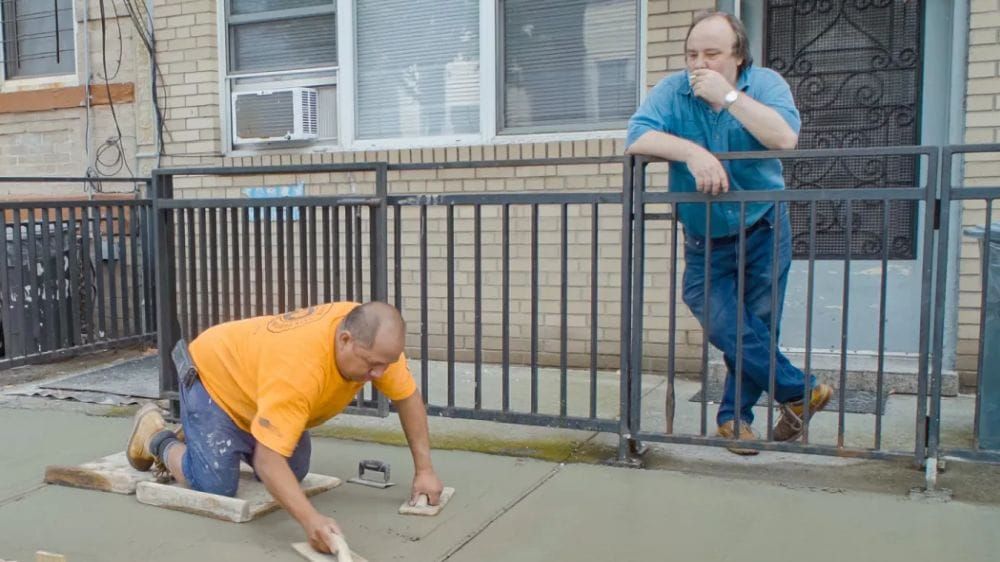
There is a, shall we say, modest through-line of Wilson attempting to make a documentary about concrete through the prism of a Lifetime movie—a reaction to both the ending of his HBO series as well as the writer’s strike. I’m not sure it really works, but it is often amusing in how he manages to weave in all sorts of unexpected detours. A weeks-long 3,100-mile funrun dedicated a deceased cult leader and his favourite tree in a school playground? Sure. A struggling musician and his unexpected connection to a high profile judge and rapper DMX? Obviously. There’s even Jacob Elordi sitting next to Kim Kardashian at one of those bizarre Hollywood affairs you hear about and rarely actually get to glimpse inside of. A sequence about a 3D-printed Starbucks store (like, the whole store!) reminds you that you are still watching a movie about concrete and that it’s really kind of an unexpectedly interesting subject. I found myself wishing Wilson actually did focus on a little bit more on that when he was at times maybe having a little bit too much fun with his coterie of peculiar faces and even more peculiar personalities.
Is it condescending to many of its human subjects? Perhaps. While a lot of humour is mined out of people (and their lives) who are poor and/or what one might call ‘affected’, I actually think it’s at its funniest when focusing its camera on the absurdity of American life rather than the people in it. A bricklaying competition had me wildly guffawing, while there are observations here about the absurdity of modern life that are at once hilarious and touching. It’s also quite clearly very self-deprecating as well as honest about what is required to undertake a project such as this. Although Wilson’s own daggy dad jokes and goofy puns did make be groan and roll my eyes, though, which is probably what he wanted. It’s definitely too long in a way that made me understand what could make the How To television series so popular, but I had a very fun time and I learnt a lot about concrete! How ‘bout that?!
If you would like to support documentary and non-fiction film criticism, please consider donating by clicking the above link. Any help allows me to continue to do this, supports independent writing that is free of Artificial Intelligence, and is done purely for the love of it.