WTO/99 (dir. Ian Bell)
A successful all-archival documentary is actually really hard to achieve. Many don’t even try it because foregoing narration, talking heads, and any other sort of directorial embellishment is not easy and breaks something of an unspoken link between the film and the audience. You have to be really firm in your belief that the material you have to work with is compelling enough that all a viewer will need are their eyes and ears, their mind and in some instances their heart to get to the core of its vision. You really need to have faith in the storytelling that can be crafted almost exclusively by editing—what to include, what not to include, how long to stay on any given image, and how you communicate the passage of time and narrative—and that it will be tight and locked in. A filmmaker has no real chance to stray or deviate outwards. They are entirely indebted to the material at hand and what it shows us and can say about humanity at a specific moment in time.
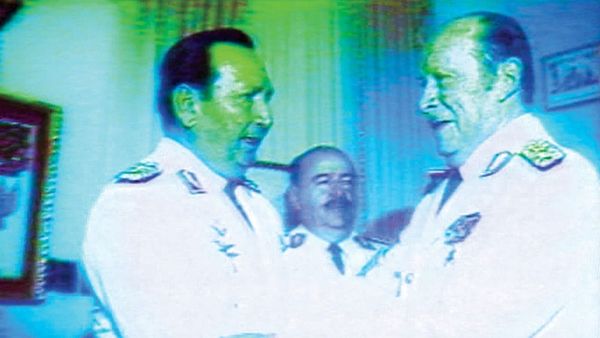
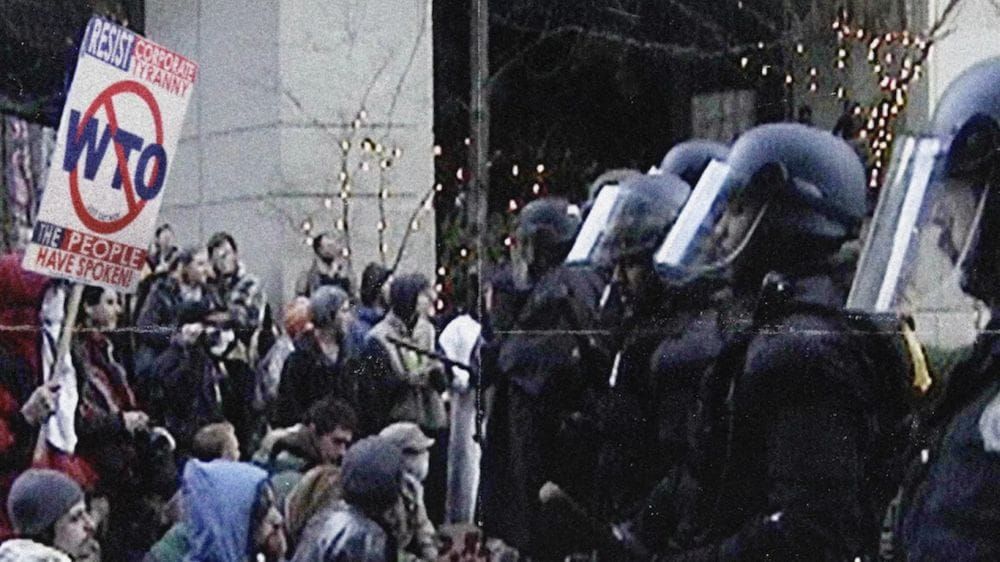
With what is rather miraculously only his first feature film, director Ian Bell has achieved something very special with WTO/99. For he, along with his co-producers Alex Megaro (also a co-editor with Bell) and Laura Tatham, has delivered a film that is propulsive, compelling and ultimately damning, It speaks to the moment then and now in ways that are both clear as day and others that are murkier and less apparent on the surface. It corrals video footage from police, the public and local news (hello KIRO 7 News Seattle!) to tell of the disastrous World Trade Organization conference of 1999. An event that in retrospect feels like something of a bellwether for the next 25 years that would follow. Undertaken beneath the overcast skies of the Pacific Northwest, growing progressively gloomier as each of its four days passed, descending into anarchy at the hands of zealous law enforcement in riot gear and smug politicians all of whom were deaf and blind to the substantive complaints of the protesters that descended upon the city in the dying days of the twentieth century.
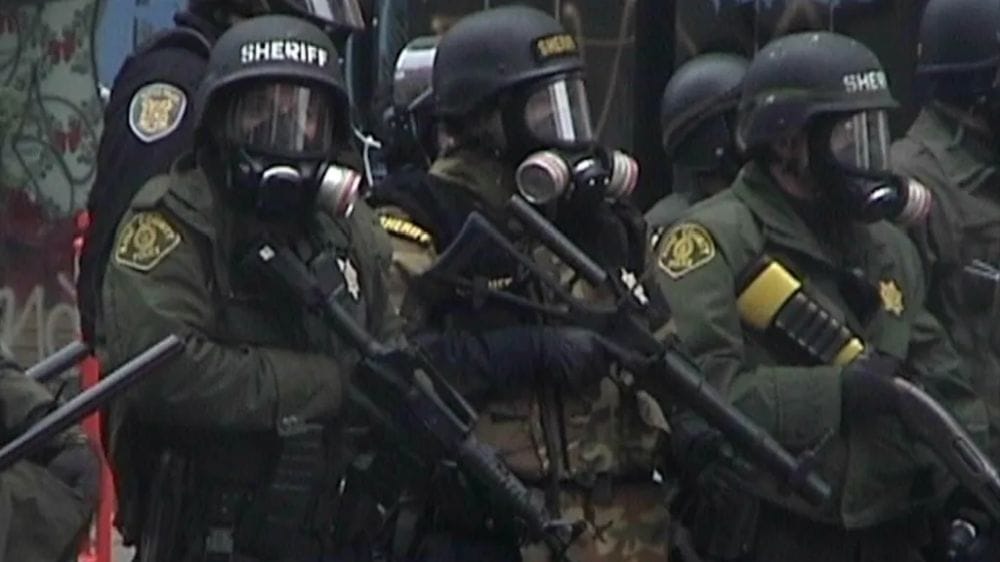
I really like this form of non-fiction filmmaking. Bell has assembled his footage in chronological order, beginning with the Seattle Police Department’s own internal video newsletter, Beyond the Badge, on through the conclusion of the conference with a coda that proceeds to September 11 (in what I admit is an odd stinger that doesn’t sit well with me—no Occupy Wall Street?). Unfolding over the four days of the event, we do occasionally get on-screen titles informing us of what was happening: a state of emergency being announced, the use of gas and rubber bullets by police, the arrival of President Bill Clinton in the dead of night. Occasionally we venture out beyond the frontlines of the protest movements in downtown Seattle—moments like Jello Biafra speaking at a Dead Presidents concert, police preparing for riots on a football field, and a government press conference announcing curfews being among the most prominent. It is built entirely out of what was available on all sides of the event, and Bell quite clearly has his opinions that he infuses throughout the 100 minute runtime.
Parallels to the modern day appear deliberately and accidentally. He knew exact what he was doing by including video of Bernie Sanders. But likely nobody could have expected the return of inflatable protest costumes to the streets of Seattle in protest and yet there they are in 1999 alongside jugglers, dancers, and fire-breathers. Occasionally, Bell and Megaro as editors get to show off a little bit as they do with footage of tear gas residue wafting towards the sky as the sun sets behind the city. What a shot that helps to break it out from the rigidity of its storytelling and instead give the viewer a real sense of time, place and importantly the mood of the setting.
Luckily for those at the time and then for us watching this now, video camcorders were increasingly popular. Most of the footage amassed here is incredible to witness from nearly three decades removed. To see how little has changed and how, as ever, in the face of video evidence, police and government and the media often appear to work in tandem to obfuscate the truth. WTO/99 shows how this event has a natural follow-through from the Rodney King incident earlier in the decade. This time, the police have cameras too and it honestly doesn’t help them if their cause was to prove their side of the story. In one really interesting moment, two of the protesters are heard observing through their camera that the police have a camera training on them, too, and then it cuts to that police-shot footage. It’s moments like that that really impress me as a filmwatcher, and WTO/99 is full of them. And as we now have films like The Perfect Neighbor told entirely through police bodycam footage, Bell’s feature has something of an extra effect of speaking to surveillance and the changing face of protest as a result.
I was all set to publish this although I didn't quite know how to end the review. So I saved it and went to have dinner and then put on another film that turned out to be a sadly pertinent double-feature with WTO/99. That film was Kei Pritsker and Michael T Workman's The Encampments. That film, about the Columbia University pro-Palestine student protest movement, just highlights how much these militarised tactics to defend the establishment against peaceful protest have grown in both their absurdity and their grotesquerie. Tear gas and rubber bullets, joined by giant tanks and the public endorsement of high profile political figures in New York City and Washington D.C.
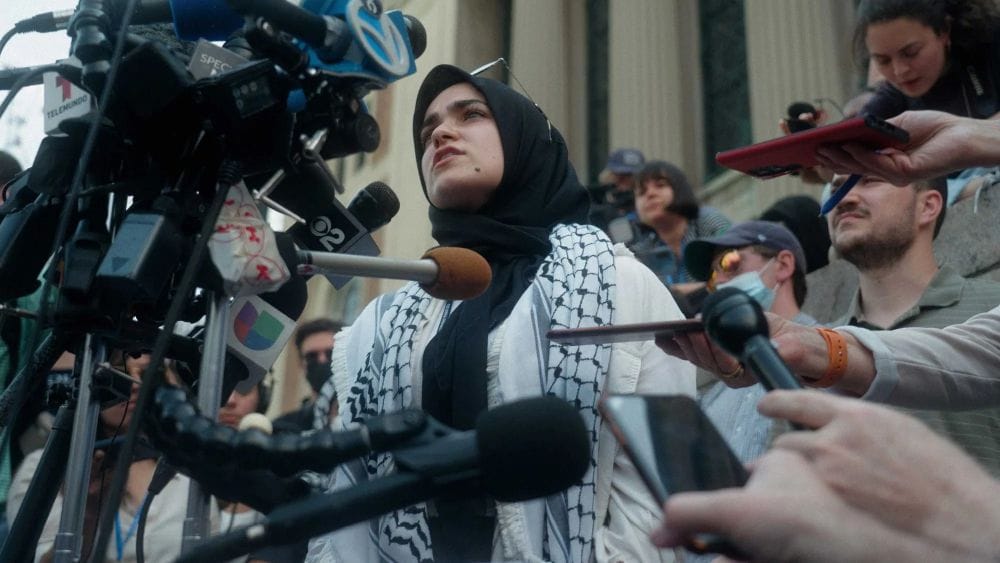
While watching The Encampments, just as I had when watching WTO/99, I couldn't avoid thinking about comments by people like Hillary Clinton who recently went on multiple stages (earning more money in the process than most of us would in an entire year) to decry young people from engaging in political discourse that they supposedly know nothing about, patronising them for finding news via alternative means to mainstream media (ignoring the fact that mainstream media has spent more than two years gaslighting the country into believing what they see is fair and just). I think of Australia's Prime Minister, Anthony Albanese, himself a former pro-Palestine protester, cowardly abandoning his own (supposed, once upon a time) morals when most convenient by using the same rhetoric while brave students took over local university spaces in honour of murdered Palestinian students.
You know, it's rare that any anti-war or even really any general pro-progressive protest movement is looked upon by those years later as being on the wrong side of history. In their film, Workman and Pritsker subtly reference Vietnam several times, including a short clip of Bernie Sanders (there he is again) saying that this could be the Vietnam protests of this generation. I have no doubt they will be seen similarly by future generations. A quarter-of-a-century earlier, the actions of those on the street of Seattle seem like they could be plucked just as easily out of today's news, speaking as they did to themes of capitalistic greed and the corporatisation of basic society. How incredibly dispiriting it all is and yet, in its way, how inspiring it is to see anybody take up arms with others to call out the systems that have been purpose built to divide humanity for the benefit of the rich and powerful. Here's hoping that "power to the people" still has some meaning in another 25 years.
If you would like to support documentary and non-fiction film criticism, please consider donating by clicking the above link. Any help allows me to continue to do this, supports independent writing that is free of Artificial Intelligence, and is done purely for the love of it.